The Dead Internet Theory is No Longer a Theory
Fishcat
Early this January, I got a message from a junior who happened to be from my college. He DMs me to tell about a jarring problem that he’s facing specifically and asked if I was available to listen to him. I said, “Yeah, go on.”
He says to me that he has had feelings for my then-girlfriend at the time and he didn’t know what to do about it. He starts describing her and how she has been super helpful to him. He didn’t know we were in a relationship.
A protective jealousy comes in play. But also the lingering suspicion saying, who even is this guy? I pretty much knew all of my juniors and just dismissed him thinking it’s a new guy.
Something didn’t seem right.
Why did he, out of all the people in the world, decide to message me when I never even knew about his existence?
I tell all this to her, and she pretty much has no reaction. A subtle smile, and that’s it. She really didn’t care, but did acknowledge his existence. This was during the second month of our relationship.
We used to talk on video calls often, and she liked to show me pictures of all the posts she liked, since I actively avoid being on social media. Then she shows me some embarrassing comments I made on Instagram earlier, and I cringe at them and laugh. That’s when I noticed something when seeing the “leave a comment” box in Instagram.
She herself was the guy that was DM-ing me.
The Social Infection
Meta announced the creation of AI generated profiles on Instagram at the start of this year which ended rather badly.
People started messaging these bots and soon they started acting weird. Here’s a thread by Karen Attiah on Bluesky about a chat of a conversation when asked about its true nature. These soon were deprecated by Meta due to significant backlash.

If that wasn’t bad enough, there’s AI integrated everywhere.
You’re being forced to shove down your throats - Meta AI, Snap AI, Grok and even ChatGPT in your freaking iPhone with every waking hour.
Back in the dotcom bubble, everybody was getting a domain with a .com in it, and now it doesn’t seem that different either. It’s the AI bubble now. More on that in a future post.
There are literal multiple accounts and channels on the internet that have purely AI generated content, AI commentaries, AI subscribers and even AI management of multiple channels at once.
You can see hundreds of tutorials online of how to make an AI influencer and automated content that generates and publishes itself at set periods of time. You can see one here, which made me curious to do it myself.
But of course, this blog is totally against that kind of stuff.
Most of these steal from other creators and platforms which doesn’t contribute to creativity or the actual creators getting any sort of recognition or well-deserved credit. Check out Farrell McGuire’s video on YouTube AI slop, I loved how in-depth he goes into these and you’ll understand what I’m talking about.
BRR BRR PATAPIM
If you don’t know, or haven’t heard what this word means, I envy you.
You’ve essentially saved yourself from the crap that gets fed to 99% of all the Gen Alpha kids 24/7 these days, and my little brother is from that age group, thus I know. It’s called brainrot, and significant research shows that it affects even AI, so imagine what happens to your poor brain.
This is “entertaining” content that is repetitive, involving fast visuals with absurd sounds with no intellectual value, no kind of usefulness or positive value attached to it. The brain registers such content in the psyche and desensitizes your dopamine receptors. This makes anybody watching this not just impatient, but bored of life’s mundane realities.
What’s worse is all of this is AI generated, and it’s just increasing in number as things like Sora get more popular throughout.
The more your dopamine receptors are in constant exposure to this, the harder it is for you to focus and do something meaningful for longer periods of time, making the effects of the Dead Internet more profound than just the obvious cluttering of the Internet.
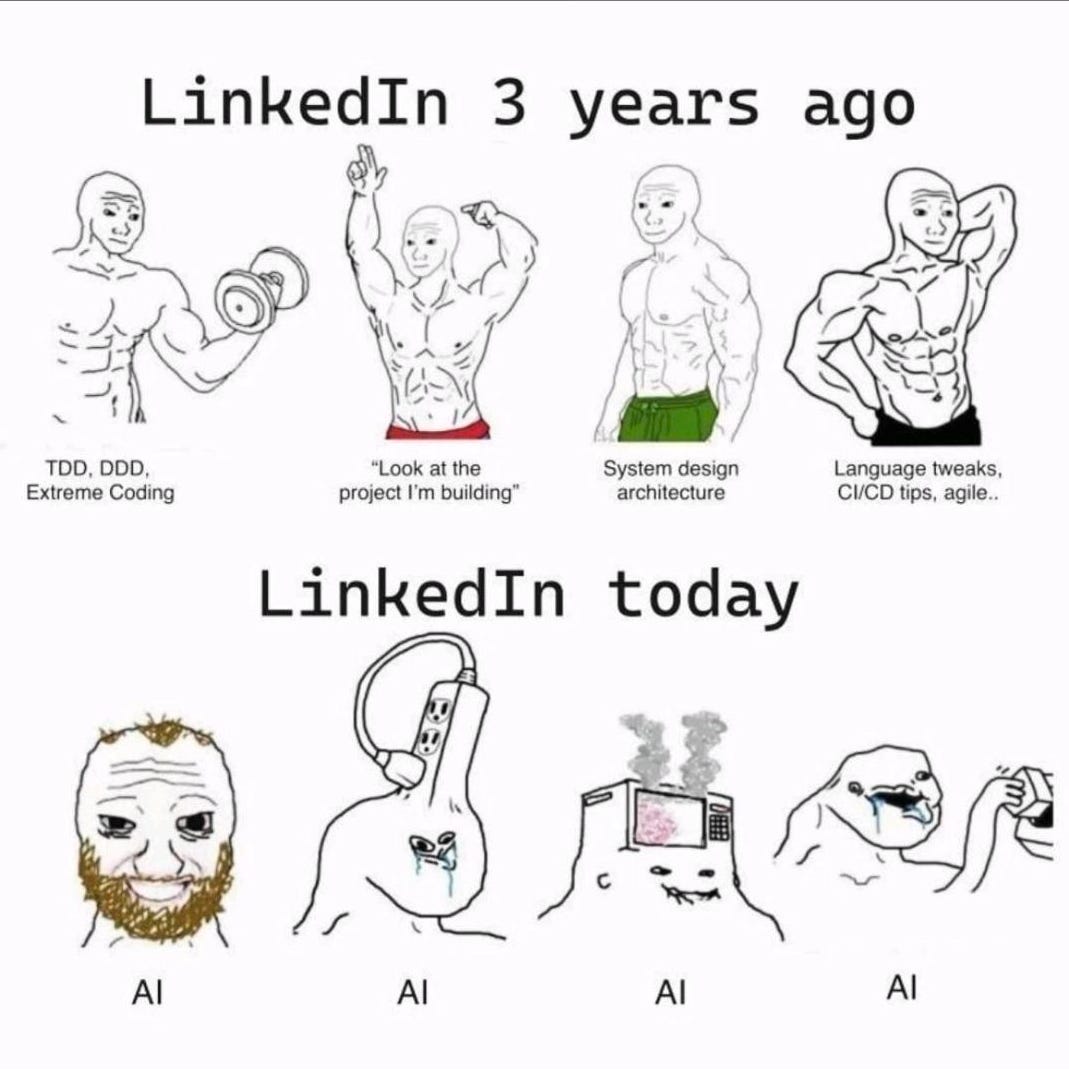
Got this banger of a meme from LinkedIn itself, which has become indistinguishable from AI slop these days. I abhor going there sometimes.
This is supposed to be somewhere where you connect with people that have the similar and diverse mindsets about work and a professional life just like you do. If everything there is AI, just for the sake of gaining traction and then getting a job, where does the authenticity part come here? Where is the diversity and uniqueness if everyone is blurting out the same AI stuff everywhere?
Junior developers get fed the same generic trash fed to them whenever they come up on the site, while senior developers either don’t have the time or don’t even bother to post themselves on the platform to teach aspiring future developers. This spirals into a no-filter, low quality feed for people to browse, eventually dulling their curiosity (if any) and providing nothing educational or insightful for people to engage with.
There are special gem-like creators who still post genuine, insightful content on Linked, and I’m glad they exist. We need more such creators everywhere.
I see job postings all the time about how they won’t tolerate AI and how they don’t hire anyone who uses it, but then proceed to hire someone who uses AI anyway and ignore people who genuinely know the craft. Absolute bonkers.
Heck, they’re using AI to now even recruit new employees, which is known to discriminate between potential candidates and often just reject employees out of pure ignorance.
AI is being misused on a scale unimaginable.
That does not, however, make the technology itself evil.
You can use it to improve upon your work and suggest improvements, or even check out for possible mistakes. It’s something I do myself. But authenticity is rare these days. I understand that I can get AI or a custom GPT write my posts or articles for me, but that’s just saying you have no creativity or effort of your own. And of course, no AI can replicate in real time, your thoughts, your experiences, and of course the way you will write at that exact state of mind you are in.
Where’s the fun in that?
Where’s the experimentation?
Where’s the natural way you talk to your audience?
I mentioned in a previous post that these exact bots and AI can be used for cloning your voice and scamming your loved ones and even tricking your bank manager into thinking it’s you.

Aitana López is one of the AI influencers in today’s modern world, and if you’re thinking if she’s real, she’s absolutely not. She even has an OnlyFans account and rakes in over 10,000 USD per month.
The Dead Leverage
This is a lose-lose situation.
Here’s the deal:
I give you a platform where I promise you all the news that’s going on in the world (information overload and FOMO), social connections with the people you care most about (and celebrities you don’t), and in return, I sell your data and feed you content that is run by an algorithm designed to keep you hooked and stressed.
Sounds good?
That’s what most people sign up for when signing up to any social media platform.
People like Zuckerberg buying Instagram and WhatsApp, while Elon buying X is just another spectacle of monopolizing the social media market and dominating the whole social landscape. This puts control by just two individuals.
The Zuck brought ads to the mainstream, while X commercialized the blue tick verification, which he also copied.
Elon Musk has been talking about completely revamping X’s algorithm by making it fully moderated and monitored by Grok, their AI assistant, and that brings about an interesting change in the platform — every single post and media will be checked by Grok to curate everyone’s feeds.
This promises a lot of small creators to rise to something better, get more exposure to their work which well deserves recognition, and gives rise to lowkey posts that would otherwise be left in the depths of the platform. I like this change.
X recently added a feature that exposes another problem: account locations. The backlash was expected, but the benefits outweigh the cons. Ignoring the privacy concerns, this is one good way to check whether what you see is actually misinformation.
X will now show where each account is based and the results are as funny as you might think. We got Indian accounts posing as Americans who are avid Trump and Israel supporters and Scandinavian women talking about how they want a husband and raise a family… all the while being based from Nigeria.
Designed to instigate people and portray a level of hype and support that doesn’t exist, these are nothing but to distract, divide and mislead people amongst one another.
But here’s the thing: these aren’t separate problems, they’re interconnected.
The feedback loop is the entire problem.
The algorithm incentivizes AI slop, because creators (real or not) push them relentlessly to the internet at set intervals, showing the algorithm that the account is “consistent”. These same bots amplify engagement on those posts, which the algorithm notices and promotes harder.
Elon might be historically against AI, and Zuck embraces the technology as his newfound love. But both of them are similar in one thing.
Their quarterly reports depend on bot inflation.
Their business models need AI.
As much as they would like to say otherwise.
Half of their engagement rates on their platforms go down the sewer if they even hint at taking down bots.
That’s the catch.
That’s the system.
I, for the longest time, have been enthusiastic about having a YouTube channel where people can follow me (it’s here), and I’ve been seeing this gain traction in YouTube too, where people are using deepfakes to make videos for them so that they don’t have to anymore.
This opens up a lot of time for them to actually do other things, but again, the authenticity in this goes out the window. That’s something I care about a lot, and calls for you to notice something.
The moment people started prioritizing money, socialization and genuine passion over legitimate content designed to help or benefit people, was the moment the Internet died. They don’t care about your wellbeing. They just care about money.
Come to talk about the Internet being dead.
I talk more about this in my manifesto.
Psychological Warfare
The media is the most powerful entity on earth. They have the power to make the innocent guilty and to make the guilty innocent, and that’s power. Because they control the minds of the masses. Malcolm X
The cost of the dead internet is trust and behavior change. Thought-police, exactly how it was portrayed in George Orwell’s book, 1984. A must-read.
The CEO of Patreon extensively talks about how algorithms are, in real-time, changing how you think about content creation and your authentic voice in his speech, Death of the Follower. Do check it out, as it opens up the world of thought control in modern social media.
The death of actual human connection and socialization has been the result of commercializing and monopolizing the social media platforms by several actors acting solely for their financial interests.
Sure, connection still exists. You need to find it, just like everything else that is worthwhile.
But this has been metaphorically kicked and paralyzed in the shins, making it harder for people to initiate, gain or even provide the breeding ground for such interactions.
The chances of you getting someone’s last crypto savings and free nudes are higher than someone actually trying to connect to you or your content.
The amount of misinformation (and disinformation) being spread by verified accounts (nothing is being done about it actively) is an important factor to consider, and research from ProPublica, a non-profit, just demonstrates how this has increased ever since the blue check reform that Elon Musk made in 2023.
This is not a problem specifically caged within X, but with most mainstream platforms you see out here.
I’ve mentioned before how social media exploits our tribal psychology and tricks us into thinking that netizens of the Internet are our tribe, while a major research paper suggests that AI is 4-6x more likely to convince you of an opinion than an actual human being.
This is a war between algorithms and your natural human psyche.
The onset of these dead entities pose as a manipulation tactic for making you think a certain way that aid towards corporate and political interests (or even trolls) by actors who want nothing but their benefit. Algorithms are manipulating you in real time of what you should think about and algorithms themselves are being manipulated by content that is essentially a repeat of whatever there already is, with the illusion of engagement.
What if someone (or something) popularized a specific medicine that “saves lives” but in reality does the exact opposite? Those are the types of things we should be aware of.
Research reports from this year clearly indicate that more than 50% of online traffic is solely from bots, outlined by Imperva.
Do you understand how much of everything you’re seeing online is created by lifeless entities like this that do not separate right from wrong?
A lot of people, and I am guilty of this myself, go through a withdrawal as a result of knowing this — a withdrawal from posting, engaging with content, second-guessing real people, and a linearly eroding trust on everything that you see on the Internet.
Look, skepticism can be healthy. But don’t let that turn into paranoia.
I can be skeptical, or dismissive of Shrimp Jesus on Facebook and an Instagram reel claiming to be able to “naturally” change your eye color, while being critical what a Donald Trump supporter claims and what Jack Dorsey thinks about social media.
Don’t conflate skepticism with paranoia either.
I will be writing a complete article about media literacy soon, which will be another topic we must address as conscious people consuming on the Internet.
[insert article content here]
Detecting the Dead
X’s community notes is a game-changer, and I personally love it, but the people who are initially exposed to each post without the notes, might not know even if the account, or the post is fake or not, especially given if the post is from a “verified“ account. The approach is half-baked, and can be improved IMO.
Instagram has been showing locations of user accounts for a while now, and it’s great that the town-square of the Internet, X, is following their footsteps. And that is exactly one way how you can identify if the person you’re seeing posts from is legit.
For example, you see a man posting die-hard content about MAGA and Elon Musk - when you see the account is based in Dhaka, Bangladesh - immediately unfollow and block that person. That makes the platform recommend the profile less to other people who might otherwise be susceptible to fake individuals like this.
Two birds with one stone.
Do they have very generic or Reddit-like language when engaging with other people? That’s another sign that a bot is talking, not a real person. Often times, even this is not enough, because I personally feel that a lot of people, with the use of AI, are also picking up their lingo as they get a continuous exposure from it.
You know why I say Reddit-like? 40-60% of Reddit is bots. That should explain pretty much everything about the dead.
I recently saw this post on LinkedIn about detecting AI-generated posts by yourself, you should check it out here. Beautifully notes out all that you can notice about an AI taking over your experience.
Another non-obvious, but surefire way to check if you’re dealing with a bot is noticing their engagement pattern. This is a trickier one, but once you get the hold of it, you’ll see the pattern every damn time.
See how active they are, and how often they interact with content. If they have no clear offline period, and/or if they engage with a lot of content at once (multiple likes on posts and comments in a short period of time) — they’re definitely engagement farmers, aka bots. Maybe even a part of a swarm of such dead entities.
During my time in X, my feed was very prominent with this.
There were posts which go along the lines of:
“Aspiring creators, let’s connect with each other under the comments section. I follow everyone.”_
This primes you to interact with it, if your goal is to grow your social media, but most of the time, it’s just a way to get free engagement under other people’s posts, not your own. I happened to get 2 followers from engaging with about 9 such posts, but it was very eerie.
I looked into their profiles and I just saw a blatant push of randomness.
Furniture posts now, political posts a bit later, their bios are saying they are writers or entrepreneurs, following anyone and everyone. These weren’t normal people trying to grow on social media.
These were bots interacting with other bots posing as real people to drive an unnatural engagement.
Are we doomed?
I’m rather very optimistic about the whole situation.
Here’s how we fight back, individually and collectively.
Andrew Kirby is a YouTuber I have been following for quite a while now, and he puts this perfectly, about the importance of limiting the amount of people that you watch content from:
The more people you are subscribed to, the more you’re letting other people brainwash you and effectively shape you and your beliefs.
When you lower the amount of people and channels you consume content from, this becomes a highly effective and efficient tactic in choosing only quality sources of information, keeping your chances of being affected by information taps with ulterior motives on a low level.
Couple this with set amount of times of how much and when you will consume social media, you will also gain the benefit of mental clarity, in this age of constant clutter and overwhelming bombardment of information.
Audit your follows monthly, or at least every 3-4 months, and evaluate everything you subscribe to.
Ask yourself:
Does this actively lead to my development, or is this just another way to clutter my brain with information that I truly don’t care about?
Just doing this gets rid of 90% of the detriments of the Dead Internet.
I’ve been researching about content creation and AI for a while now. Just like all the others, I had the skepticism that AI is ruining the Internet and how it is “bad”. The quality is as bad as it gets.
No, it just lowered the bar for creating content.
I quote Naval Ravikant in Joe Rogan’s podcast,
AI will replace all uncreative work, and that’s a great thing because all of humanity will be left to do the creative stuff.
That’s amazing.
But what does one do if they don’t create anything, like most people on the Internet?
Social media isn’t inherently evil, its implementation is.
There are obviously genuine benefits like connection, niche communities, and stuff that you wouldn’t find easily about your interests. Keeping in mind the negative aspects, and not being ignorant of them is what will set you apart from most people on the Internet.
The current model of the Internet destroys the benefits and amplifies what negative parts that it gives rise to. The algorithm prioritizes content that gets the most engagement, not that is the most educational or helpful to us. That creates a plethora of content in your digital presence that echoes the same beliefs over and over — without a positive net, especially if you are unaware that most of these are automated systems, fighting for your attention.
I joined Bluesky two days ago (here). (not anymore)
Note: And ironically I got banned by their systems for having a spammy presence, the likes of a bot. Possibly due to the fact I use a VPN for most of what I do on the Internet. They haven’t responded to me yet, but I’m hoping they’ll do it soon.
Edit: (22 July, 2026) I deleted Bluesky a few months after this, because of a bunch of things that concerned me about the platform, and it’s future. I will be explaining in a future post on what happened and why.
Joining platforms like Bluesky is another way how you can control what you see in your digital world. They have this amazing setting you configure, where you control what shows up on your feed in a very clear way.
You get to control who you see content from, whether your following feed or the trending feed should be your main focus, and starter packs, which give you a headstart on who to follow, which has a much lower chance of having someone there as a bot.
Mastodon is another platform that’s similar to Bluesky, and also supports the decentralization of free speech, thus deterring any central identity to shun your voice or not speak your mind. These two platforms have amazing moderation teams, and I bet you’ll like it. I personally lean more towards Mastodon ;)
But how do you promote the continued push of genuine human content?
You support writers, like us, with a financial incentive. Substack does not pay us even if we have millions of subscribers. Subscribing to a free newsletter does not guarantee us any financial gains to keep going. These are just mediums to share our minds with you, the reader. Any donations, a small tip, or even words of affirmation (and suggestions!) in the comments or DMs means a lot to writers like us.
At the very least, you can like this post, share it with a friend and subscribe for more posts like this. This ensures that you contribute to the movement that demands a return of the actual, authentic Internet and so that the next generations do not get slop down their throats whenever they go to the digital realm.
This blog is the call to resistance against the growing dead internet.
Join us in the resistance, but don’t — if you think it’s an AI telling you to do so.
Stay skeptical, but know who to trust.
This is a lesson for both in real life, and while on the Internet.
- Kaifi
My manifesto against the Dead Internet: Being Alive In a Dead Internet